

Noises Off – Footnotes
The Footnotes to our episode on Michael Frayn’s comic masterpiece Noises Off include extracts from the fictional programme to Nothing On, the play-within-the-play, and a reprisal of one of the best jokes in the play.
Not listened to the episode yet? You’ll find it here.
The Nothing On Programme
Frayn’s conceit of the play-within-the play extends to his including in the published text of Noises Off extracts from the programme for the fictitious farce Nothing On for its run at the Grand Theatre in Weston-Super-Mare. They include hilarious biographies for the cast that underline the mediocrity of their achievements, and of the production they are appearing in. The author of Nothing On, for example, Robin Housemonger, was a “gents hosiery wholesaler” before writing his breakthrough play, Socks Before Marriage, which amazingly “ran in the West End for nine years”. Horrifyingly, “Nothing On is his seventeenth play.”
Several of the cast claim a similar amount of modest fame from having worked together on a TV sitcom entitled On the Zebras, in which Dotty starred as “Britain’s most famous lollipop lady”, Mrs Hackett. In fact miraculously all of Dotty’s acting credits to date comprise characters whose names rhyme with her part in Nothing On, Mrs Clackett. Garry and Brooke both appeared in On the Zebras; Garry becoming a household name, so to speak, playing “‘Cornetto’, the ice-cream salesman who stirs the hearts of all of the lollipop ladies”. Brooke’s credits mainly consist of nameless bit parts, in which she wears not very much, as she does in Nothing On.
The remainder of the cast also seem to have been type-cast in their careers to date: Garry’s TV work is restricted to nothing other than police dramas, Freddy’s to medical shows, and Belinda, after training as a music-hall dancer, has more recently been seen in a sequence of sex farces not unlike Nothing On. Selsdon “‘first trod the boards’ at the age of 12 … in a touring production of Julius Caesar, with his father…in the lead.” In the subsequent 50 years he has toured Shakespeare all over the country, but rarely in any role beyond a spear-carrier. “His most recent film appearance was as Outraged Pensioner in Green Willies.”
Lloyd, of course, has pretensions beyond his station as the director of Nothing On and this hapless troupe. As he points out in the play, he is an English graduate and his next job is a production of Richard III. The programme note rather belies his pretension, stating that “he has probably become best known for his brilliant series of ‘Shakespeare in Summer’ productions in the parks of the inner London boroughs”, which no doubt is where his Richard III may be found.
The Weston-Super-Mare programme even includes credits to the providers of props for the production, inevitably referencing the supplier of multiple plates of sardines by ‘Old Salt Sardines’. Strangely, the list also includes credits for items that do not actually appear in this show. A quality of detail worthy of the production of Nothing On itself.
The Nothing On programme also reprints a spoof scholarly article on the “Semantics of Bedroom Farce”. It is a surreal parody of academic analysis, in which the author suggests metaphoric readings of the common features of the genre of farce, concluding that “laughter…is a metaphoric representation of the sexual act.” In fact, given how intoxicatingly funny Noises Off is, the author may not be so far off the mark. The article is reproduced in full in the programme for the current production of Noises Off in London’s West End, and I can’t help but wonder how many in the audience are puzzled by its serious claims. Another triumph of Frayn’s art within art.

Nothing On Programme
Grand Theatre, Weston-Super-Mare


“Ladies and Gentleman, please take your seats…”
One of the funniest running jokes in the play is the mix-up backstage in Act 2 over the front-of-house calls that Tim and Poppy make on the tannoy to count the time down to the start of the show. In the chaos of the comings and goings of the cast prior to the curtain, Tim and Poppy each make announcements to the audience without knowing what the other has previously announced. Poppy repeats Tim’s first warning that the curtain will rise in three minutes several minutes after Tim’s first call, the curtain apparently not getting any closer. Tim next announces that the show will begin in one minute, but on learning that Poppy had actually said three minutes rather than two, he tries to re-establish a sensible order to proceedings by immediately announcing that the curtain will rise in two minutes. Time is now going backwards.
Lloyd reports from out front that the audience is rightly confused, with old-age pensioners heading for the Gents at the three minute warning, only to rush back out when Tim jumps ahead to one minute.
Shortly after Poppy gives the final warning that the show is “about to begin”, Tim proceeds to repeat the same announcement, but realising his mistake improvises and adds “at any moment”. Time is moving forward again, sort of.
Please forgive my pedantic reprisal of the joke – clearly you had to be there. Suffice to say, I cannot listen to front-of-house curtain calls without thinking of Noises Off and imagining what may be going on backstage.
The Texts

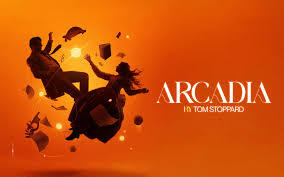
113 – Arcadia by Tom Stoppard
Published 24th August
Tom Stoppard’s 1993 play, Arcadia is viewed by many as his finest play, renowned for the breadth of its intellectual interrogations and its formal invention. The play is a structural masterpiece of ideas, as well as a teasing detective story, joyous comedy, and emotionally rich exploration of love and loss.
As we record this episode a wonderful new production of Arcadia is playing at the Duke of York’s theatre in London’s West End, following its acclaimed run at the Old Vic theatre earlier this year. I am delighted to share the challenge and the pleasure of exploring Stoppard’s dazzling drama with the director of the new production, Carrie Cracknell.

112 – Glengarry Glen Ross by David Mamet
Podcast: Play in new window | Download
Follow the podcast Apple Podcasts | Spotify | Amazon Music | Android | iHeartRadio | TuneIn | RSS | Follow the podcast
David Mamet’s modern American classic, Glengarry Glen Ross, is a blistering commentary on the cut-throat reality of the American dream, and its poisonous impact on those who have bought into the myth and machismo of that dream. The play had its world premiere in the small Cottesloe theatre at the National Theatre in London in September 1983, and was first performed in New York the following year, winning the Pulitzer Prize for Drama. Mamet also wrote the extended screenplay for the star-studded 1992 film version.
As we recorded this episode a new production of the play was playing at the Old Vic theatre in London, with an all-female cast. This is a particularly provocative idea, because one of the primary themes of this play is masculine identity, and the salesmen in this Chicago office do not hold back in their display of machismo.
To explore Mamet’s unflinching slice of 1980s dog-eat-dog capitalism, I am joined by arts journalist Mark Lawson.

111 – The Resistible Rise of Arturo Ui by Bertolt Brecht
Podcast: Play in new window | Download
Follow the podcast Apple Podcasts | Spotify | Amazon Music | Android | iHeartRadio | TuneIn | RSS | Follow the podcast
Bertolt Brecht’s ‘gangster spectacle’, The Resistible Rise of Arturo Ui, is both an exuberant and funny piece of theatre, and a chillingly topical political satire. Set in the 1930s Chicago of Al Capone, Brecht presents a parody of the rise of Hitler through the character of the gangster Arturo Ui. The play is a universal cry for vigilance against the rise of unscrupulous, populist leaders who threaten democratic societies and global peace.
As we recorded this episode a new production of the play by the Royal Shakespeare Company was playing in Stratford-upon-Avon, starring Mark Gatiss as the title character.
I am delighted to be joined by both the show’s translator, playwright Stephen Sharkey, and by Brecht scholar, Professor Tom Kuhn, to guide us through Brecht’s political parody.

0 Comments